
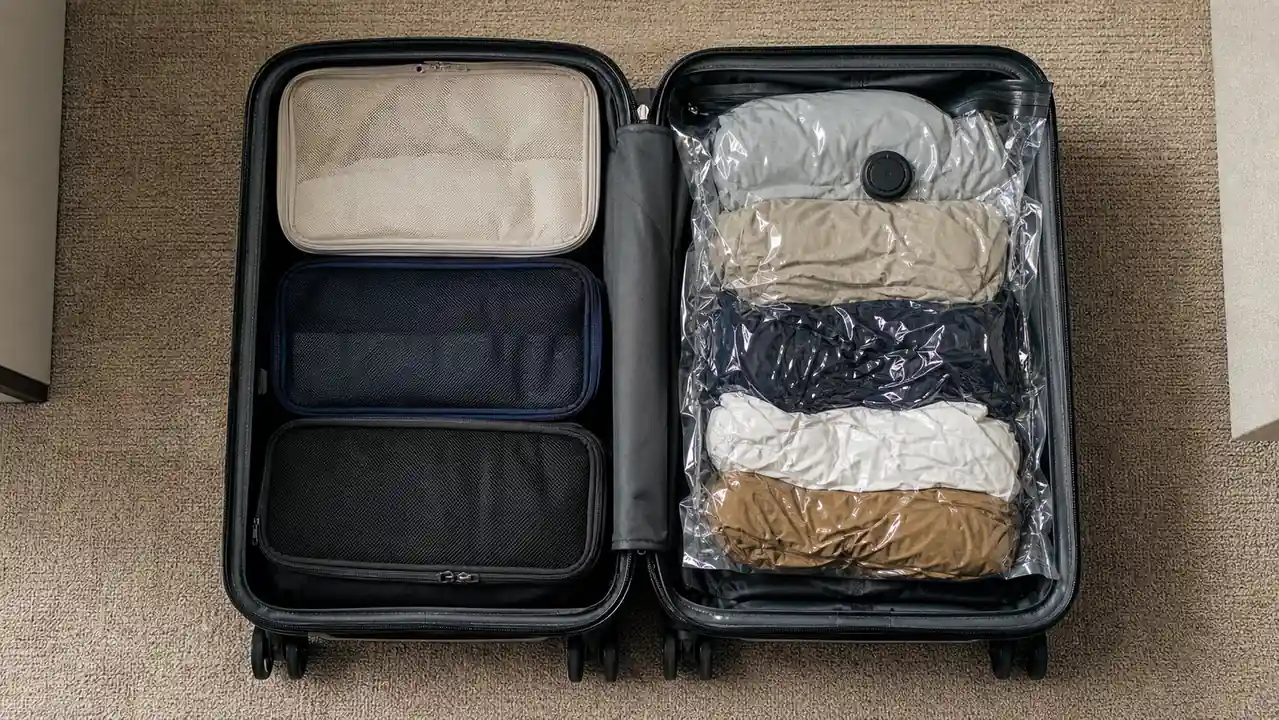
If you've stood in a hotel room at 6 a.m. trying to jam three days of clothes back into a bag that closed easily on the way there, you already know the real question isn't which system saves more space on the shelf at the store. It's which one still works the same way on your twentieth trip as it did on your first, when the return flight is in two hours and you're not in the mood to fight with a zipper or a stuck air valve.
I've run both systems side by side for a year of regular travel, roughly one trip a month, mixing carry-on-only weekend runs with a couple of longer checked-bag trips. The setup was a set of BAGAIL packing cubes on one side of the suitcase and a compression bag kit from a different, well-known travel brand on the other. Same carry-on, same rotation of clothes, same routine of packing Sunday night and unpacking Wednesday morning before work. The short answer is that compression bags win on raw volume the first few times you use them, and packing cubes win on almost everything that matters after that, including the volume number itself once the compression bag starts to wear.
This isn't a lab test with a single measurement taken once and reported as gospel. It's what happened to the same two products, packed the same way, trip after trip, month after month. That's the only test that actually predicts what you'll experience, because a product that performs great in week one and starts failing in month five isn't a good product, it's a product with a slow leak in the value it promised you.
If you're reading this trying to decide between the two before a trip next week, here's the framing that actually helps: think about how many times you'll use whichever one you buy this year, not how impressive it looks the first time you pack it. A compression bag that squeezes flat once and loosens up by trip four isn't saving you anything by trip ten. A set of cubes that holds its shape and its zip through fifty uses is the one doing real work the whole time you own it.
| BAGAIL Packing Cubes | Compression Bags | |
|---|---|---|
| Packed volume reduction (fresh, first use) | About 15 percent tighter than loose folding | About 30 percent tighter than loose folding |
| Volume reduction after 6 months of use | Still about 15 percent, unchanged | Drops to roughly 18 percent as the valve seal weakens |
| Closure type | Two-way zipper on mesh-top cube | One-way air valve plus roll-and-seal zip track |
| Failure point observed | Zipper pull thread frayed on one cube at month 9, still functional | Air valve stopped holding a full seal at month 5 |
| Sorting and finding items | Each cube is its own category, grab and go | Everything in one bag, dig through it to find one shirt |
| Works without electricity or a vacuum | Yes, hand compression only | Best results need an electric pump, hand rolling is weaker |
| Approximate price for a full 8-piece set | Check today's price on Amazon | Comparable 6-bag compression sets are similarly priced |
| Wrinkle control | Good, folded structure holds shape | Fair, heavy compression can crease stiff fabrics |
Where Compression Bags Win
There's no getting around it. On day one, compression bags beat packing cubes at the one job people assume matters most, fitting more stuff into a fixed space. Roll a stack of t-shirts into a compression bag, squeeze the air out through the valve or with an electric pump, and the bag shrinks to maybe two-thirds its starting thickness. For a single big trip where you're packing bulky items like a winter coat or several towels for a group vacation, that first-use compression is genuinely useful, and I'd never tell someone not to bring one for that specific job.
They also do one thing packing cubes can't do at all, they compress bulky, non-folding items. Towels, blankets, a puffy jacket you're bringing just in case the weather turns. A packing cube organizes those items but doesn't shrink them much, because its compression comes from folding fabric down and zipping over it, not from squeezing air out of the fibers themselves. A compression bag pulls the trapped air out entirely. If your trip involves camping gear, bedding, or a stack of beach towels on top of clothes, that's a real edge, and it's the scenario where I still reach for one.
The electric-pump versions in particular are impressive to watch the first time. Attach a small handheld vacuum, press the button, and a bag that looked impossible to close shrinks down to a flat brick in under a minute. If your travel pattern is one or two big trips a year where every cubic inch of a checked bag counts, that's a legitimate selling point and it's worth acknowledging before getting into why it doesn't hold up as the only system in your rotation.
There are downsides even in that best-case scenario, though. Compression bags are noisy, the plastic crinkles every time you touch the suitcase, which matters more than you'd think in a shared hostel room or on a red-eye when you're trying to grab a jacket without waking the person next to you. They also don't breathe, so anything packed damp, a swimsuit, workout clothes from a morning run, stays damp and starts to smell by the time you unpack. A packing cube's mesh top at least lets a little air through.
Skip the guesswork and start with the set that holds up past trip one
See current availability and pricing for the BAGAIL 8-piece packing cube set on Amazon.
Amazon Check Today's Price on Amazon →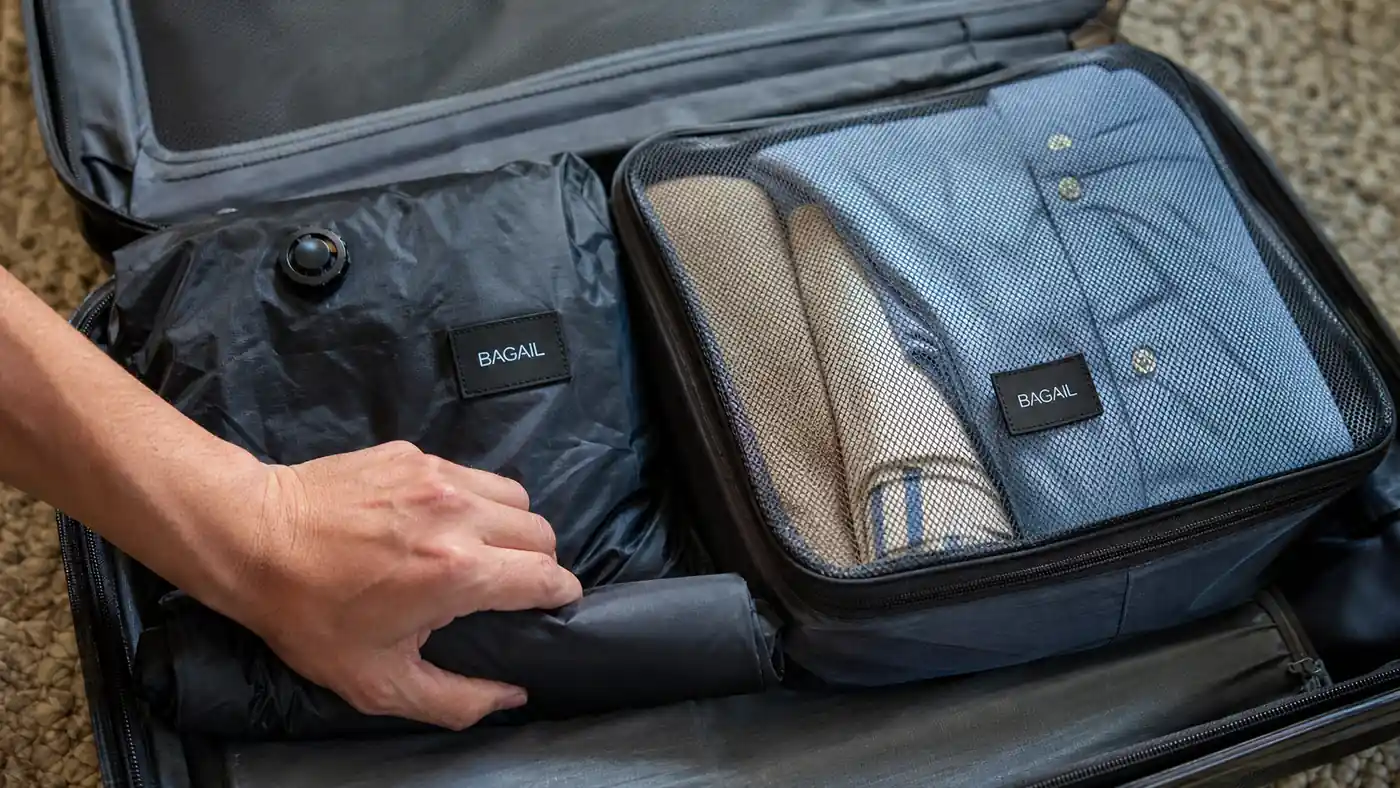
Where BAGAIL Packing Cubes Win
Compression fades. That's the part nobody tells you when they're selling you a vacuum bag on a product page full of before-and-after photos. The air valve on the compression set I tested held a tight seal for the first four or five uses, then started losing its grip. By month five, pressing the air out took two or three tries instead of one, and the bag never got quite as flat as it did new. By month eight it barely compressed at all, it was just a plastic sack holding clothes, and I was rolling the clothes myself to get any benefit out of it at all.
The BAGAIL cubes didn't have that problem because they were never relying on an airtight seal in the first place. Each cube uses a double zipper that compresses by folding the mesh top down and zipping over it, a mechanical squeeze rather than a pressure seal. There's less to fail, because there's no rubber gasket or one-way valve doing the work. Ten months in, all eight cubes still zip the same way they did out of the box. One zipper pull thread frayed at the edge on the largest cube, purely cosmetic, the zipper itself still tracks fine and closes fully.
The bigger win is day-to-day use, not the lab-test compression number. With BAGAIL packing cubes, shirts live in one cube, underwear and socks in another, a compact cube for cables and toiletry bags. When TSA wants to look through your bag, or you need a clean shirt for a dinner that starts in ten minutes, you pull one cube out instead of unrolling an entire compression bag and digging through everything you own to find one item. Compression bags treat your suitcase like one big pocket. Packing cubes treat it like eight small ones, and after enough trips, that organization saves more real time at security lines and hotel closets than the extra 15 percent of squeeze ever does.
There's also a packing-order advantage that only shows up once you've done it a dozen times. Because each BAGAIL cube holds one category, you can grab just the cube you need for a two-day side trip without repacking the whole suitcase. Try doing that with a compression bag and you're breaking the seal, pulling out one item, and either resealing a bag that's already lost some of its grip or leaving it open and losing the compression entirely for the rest of the trip.
Compression bags win the demo. Packing cubes win the year.
The Durability Gap Nobody Puts in the Product Photos
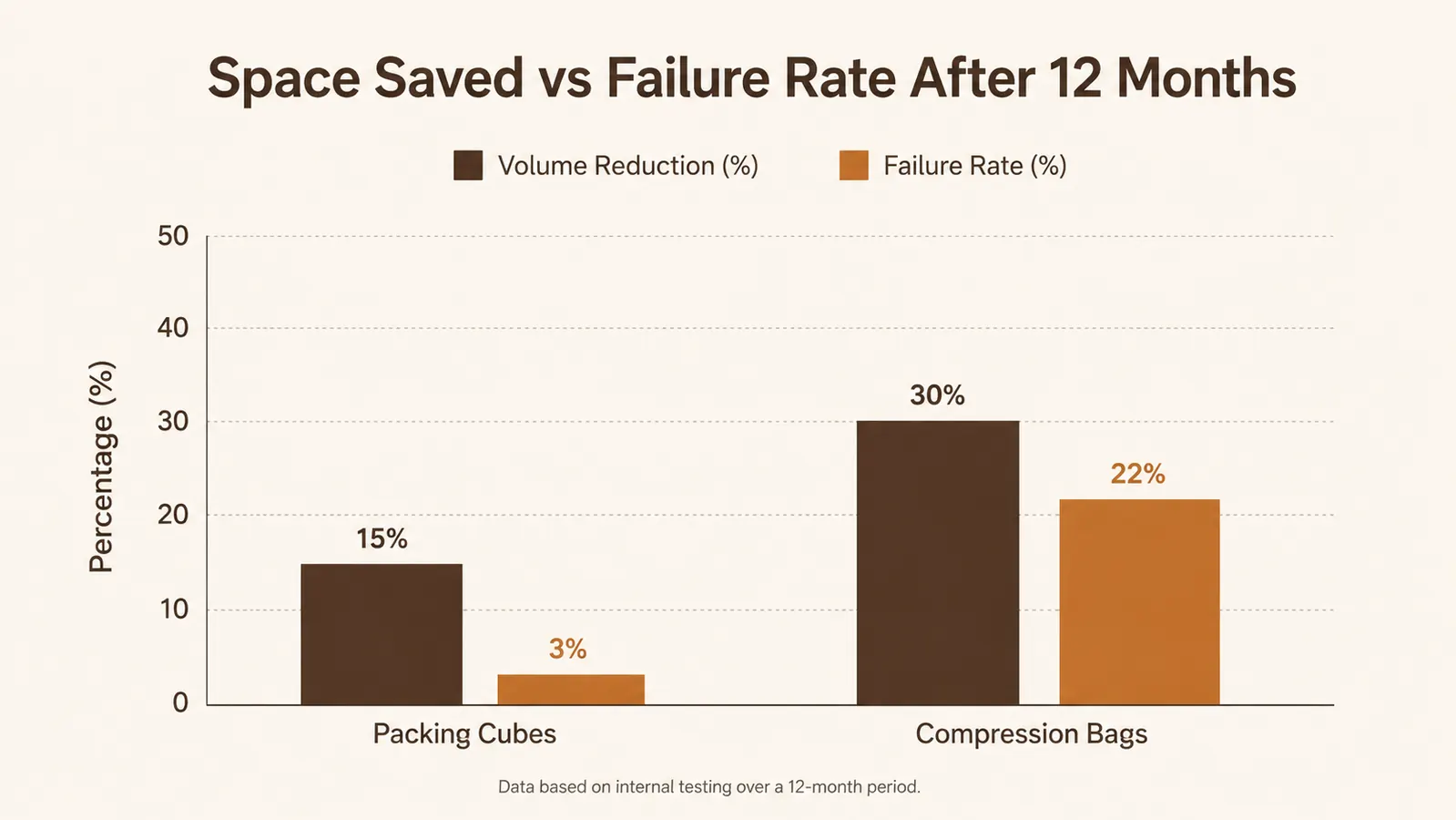
I weighed both systems packed the same way at the start of the test and again at month six, using the same items each time so the comparison would actually mean something. The compression bag's seal weakness meant I was routinely packing it looser than intended by month four, because fighting a valve that won't hold air isn't worth the ten minutes it adds to a 6 a.m. packing session when a flight is boarding. Effective volume savings dropped from roughly 30 percent to around 18 percent by the six month mark. The BAGAIL cubes measured the same both times, about 15 percent tighter than loose folding, because their compression comes from the fold-and-zip mechanism, not from air pressure that degrades with every use.
That's the trade most people don't think about when they're comparing the two side by side in a store display or on a product page full of stock photos. Compression bags advertise a bigger number, and it's an honest number the first time you use it. But it's a number that shrinks every few months as the material fatigues, the seams stretch slightly, and the valve loosens. A packing cube's smaller number is the number you'll still be getting on trip thirty, which matters a lot more if you travel often than a bigger number that only holds for a handful of uses.
Cost held up the same way. At close to the same price for a full set, the compression bags effectively cost more per trip once you account for how much of that early compression is gone by month five. The BAGAIL set costs the same on trip one and trip fifty, and that's the kind of math that actually matters if you're buying gear once and expecting it to last, rather than replacing it every travel season.
I also checked the seams and stitching on both after the year was up, since that's usually where cheaper gear shows its age first. The compression bag's seams were fine, the failure was always the valve, not the fabric. The BAGAIL cubes showed light fraying only on the one zipper pull mentioned earlier, and the mesh panels, which take the most flexing every time you compress a cube shut, hadn't torn or stretched out of shape on any of the eight pieces. For something that gets folded, squeezed, and stuffed into an overhead bin every few weeks, that's a better outcome than I expected going in.
Who Should Buy Which
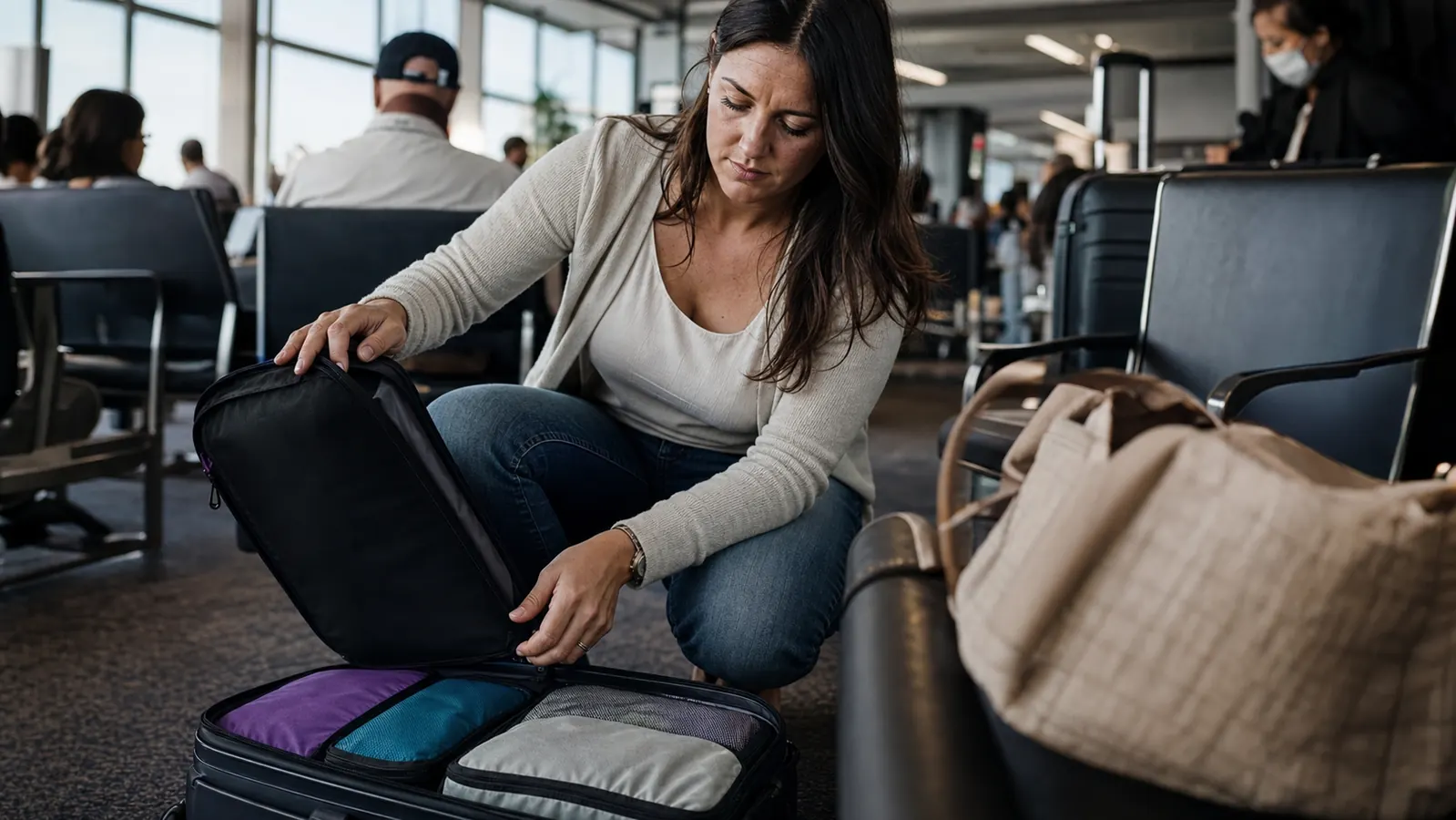
If you take one big trip a year and need to cram a comforter or a stack of towels into checked luggage, a compression bag earns its keep for that single use, and I'd keep one or two around for that purpose specifically. But for anyone flying monthly, doing carry-on-only trips, or traveling with a family where finding the right kid's shirt fast actually matters at 6 a.m. in a hotel room, BAGAIL packing cubes are the better long-term buy. They cost about the same as a comparable compression set, they don't rely on a seal that wears out over a season of use, and they turn a suitcase into something you can actually navigate instead of a bag you have to excavate every time you need one item.
My honest take after a year with both, I still own the compression bags and use them maybe twice a year for oversized items like bedding or winter coats. The BAGAIL cubes go on every single trip, carry-on or checked, because they're the ones that still work exactly the way they did the day I bought them, with the same zip, the same fit, and the same organization I've come to rely on without thinking about it.
See why these cubes are still going strong after a year of monthly trips
Check today's price and current availability for the BAGAIL 8-piece packing cube set.
Amazon Check Today's Price on Amazon →