

By the time you've cleared security, pulled up a mobile boarding pass, taken a dozen photos at the gate, and killed forty minutes on spotty airport wifi waiting out a delay, your phone is already down to sixty percent before the plane has even left the ground. Add GPS navigation once you land, a translation app in an unfamiliar city, or a few hours of texting home to check in, and a phone that started the day at a full charge can slide into the teens by dinner. That is not a battery defect. A phone working this hard on a travel day burns through a charge faster than almost any other day of the year, and charging it harder the night before does not fix a problem that shows up eight hours in, with no outlet anywhere near you.
The fix is not a bigger phone battery. It is a repeatable charging routine built around one piece of gear you actually carry every day, not just on the trips you remember to pack for. We built this routine around the INIU 45W Fast Charging Portable Charger, a 10,000mAh power bank small enough to live permanently in a backpack pocket, after running it against the way people actually travel rather than a lab bench test. What follows is the five-step system built around it: when to charge, when to plug in, and what to change about how your phone behaves, so the battery you are carrying gets you through a full day instead of running out right when you need it most.
Tired of Watching Your Phone Die Before You Even Reach the Gate?
This is the INIU 10,000mAh, 45W charger built into the routine below. Check today's price and current availability on Amazon before your next trip.
Amazon Check Today's Price on Amazon →Step 1: Charge the Power Bank the Night Before, Not Just the Phone
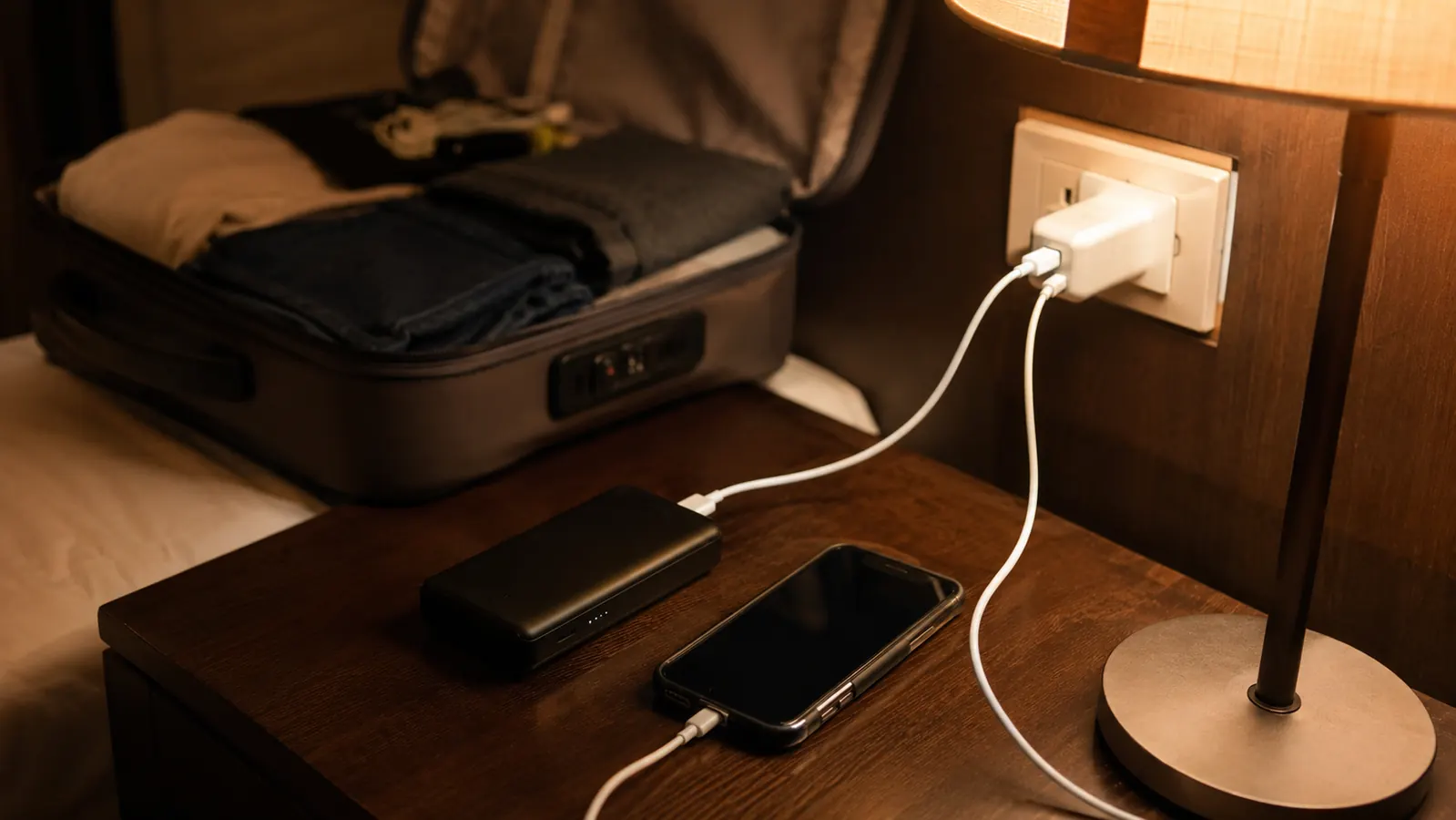
Most people plug their phone into the wall overnight and call it charged for travel. That works fine on an ordinary day, but on a travel day your phone needs to survive hours with no outlet, so the thing that actually needs a full charge the night before is your power bank, not just your phone. Top off the INIU charger to 100% the same night you pack, and it holds that charge in a bag for days until you actually need it, since a lithium-ion cell like this one loses only a small amount of charge sitting unused.
Do this the night before every travel day, not once a month. A power bank sitting half-charged in a junk drawer is worthless the moment you actually need it, and the ten minutes it takes to plug it in alongside your phone the night before is the entire habit. We keep the charger clipped to the same cable as the phone on the nightstand, specifically so neither one gets left at fifty percent by accident.
It is also worth a quick check of the charger itself the night before, not just a glance at whether it is plugged in. Look at the LED percentage display to confirm it actually climbed to 100% rather than assuming it did because the cable is connected, and give it a once-over for anything loose at the USB-C input port. A charger that quietly stopped charging three trips ago, sitting at whatever percent it had left when it failed, is worse than no charger at all, because you will trust it right up until the moment it does not deliver.
Step 2: Match the Charger's Capacity to the Trip
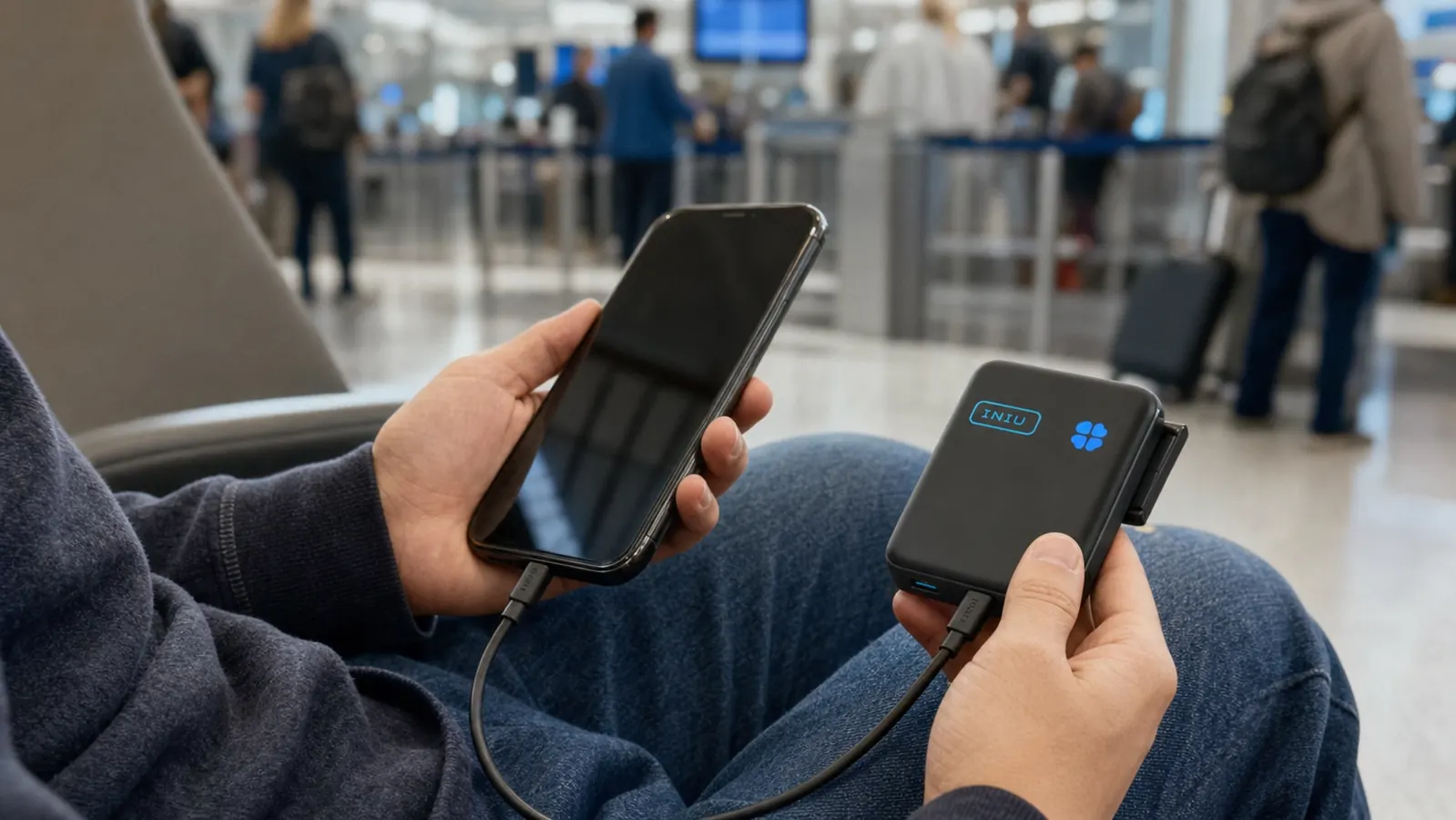
A single 10,000mAh charge is not meant to run your phone for three days with zero outlets. It is meant to bridge the gaps between outlets: a long layover, a red-eye with no seat power, a full day of sightseeing before you are back at the hotel. At 45W over USB-C, the INIU charger will take a phone from around 20% to 80% in roughly nine minutes with the cable it ships with, enough for one to two full phone charges depending on your phone's battery size before the power bank itself needs a refill.
That size also matters at security. A 10,000mAh bank works out to about 37 watt-hours, comfortably under the 100 watt-hour limit that TSA and most international carriers enforce for carry-on power banks, and the rating is printed right on the housing so you never have to explain it to a gate agent. Bigger banks, 20,000mAh and up, deliver more charges per top-off, but they add weight and bulk you will carry through a terminal on every single trip, not just the ones where you actually needed the extra capacity.
The cable you use matters almost as much as the charger's rating. Plug an older phone in over a USB-A port instead of USB-C, and you will get standard fast-charge speeds rather than the full 45W, which is not a flaw, just a different connector standard doing a different job. And a cheap third-party cable pulled from a junk drawer can measurably slow a charge down through plain resistance, so if a top-off feels slower than it should, check the cable before you assume the charger has lost its edge.
Step 3: Charge in the Gaps, Not the Crisis
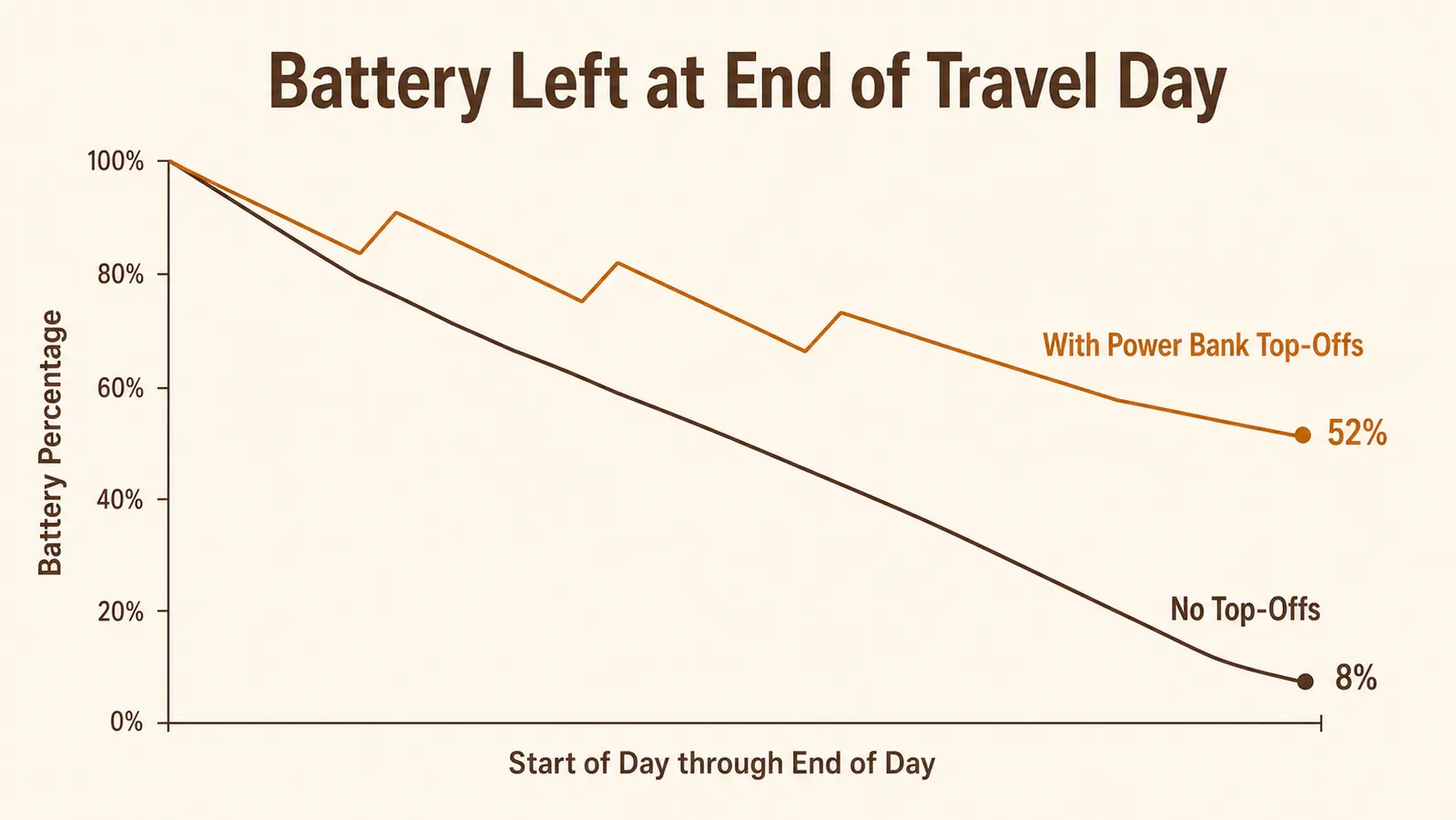
The single biggest mistake in most people's charging routine is waiting until the phone hits 10% before they think about plugging in. By then you are charging under pressure, hunting for an outlet in a crowded gate area or trying to find a seat with power on a full flight. Instead, plug in the moment your phone drops below 50%, whenever there is a natural pause: the security line, the walk to your gate, sitting down for a layover meal. A few minutes here and there keeps your phone in a comfortable range all day instead of one long emergency charge at 8%.
In one full travel day we tracked side by side, a phone with no top-offs at all started at 100% and was down to 8% by the time we boarded the last flight of the night. The same phone, topped off for a few minutes at security, again at the layover, and once more before the final descent, using the INIU charger, landed at 52% instead, more than enough to pull up a rideshare and find the hotel. That is the entire case for charging in the gaps instead of waiting for a crisis: a handful of five-minute top-offs adds up to more than double the battery left at the end of the day.
This is also where a small, always-ready charger earns its keep over a bulky one left zipped in a separate pouch. The INIU unit is light enough, under eight ounces, that pulling it out for a five-minute top-off between gates does not feel like a chore, and keeping the cable attached to the charger itself instead of buried at the bottom of a bag removes the last bit of friction. The extra ten seconds it takes to dig around for a cable is exactly the kind of hassle that turns 'I'll charge later' into a dead phone by the time you actually get around to it.
Step 4: Cut the Drain, Not Just Add the Charge
A charging routine only works as well as your phone lets it. Location tracking running in the background for apps you are not actively using, screen brightness left on auto in bright sunlight, and push notifications from apps you will check anyway all pull power you do not need to spend on a travel day. Turning on low power mode the moment you leave for the airport, not when the battery hits 20%, buys you real hours before you ever need to plug in at all.
Airplane mode does more work than most people give it credit for during a flight with no wifi, since a phone constantly searching for a signal it cannot find burns noticeably more battery than one that has stopped looking. Switch it on as soon as the seatbelt sign comes on, rather than leaving your phone hunting for bars at 35,000 feet for the whole flight, and you will land with meaningfully more charge left for the part of the day that actually needs it, navigating a new city or finding ground transportation.
Background app refresh is the other quiet drain worth a five-minute cleanup before any travel day. Email, social apps, and weather widgets that update themselves every few minutes whether you are looking at your phone or not add up over a ten-hour day in a way that is easy to overlook, since none of it shows up as one obvious battery hog. Turning it off for everything except maps and messaging before you leave the house does more for your battery than most people expect from a setting they never think to touch.
Step 5: Recharge the Bank Every Night, Same Spot Every Time
The routine only holds up if it is boring and repeatable. Every night of a trip, the INIU charger goes back on the cable next to your phone, whether it is down to 30% or still sitting at 90%, so you never start a travel day guessing how much charge you actually have left in it. Checking the LED percentage display takes two seconds and removes the guesswork entirely, since a display that actually matches the real remaining charge is worth more than an extra thousand milliamp hours on a unit you cannot trust.
The same goes for where it lives in your bag. Pick one pocket, the same one every trip, so reaching for it is automatic instead of something you have to think about mid-terminal. The whole point of this routine is that it stops being a decision you make each day and becomes something you just do, the same way you already grab your wallet and your keys without thinking about it.
Keep an eye on how many full charges the bank delivers before it needs a refill, and treat a noticeable drop as useful information rather than something to ignore. A power bank that used to get you through a full day on one charge and now needs a midday top-off of its own is telling you its capacity is fading, which happens to every lithium-ion battery eventually. That is the point to replace it, before a trip, not during one.
What Else Helps
A portable charger solves the biggest part of this problem, but a couple of smaller habits close the rest of the gap. A short USB-C cable kept in your pocket or a jacket, rather than buried in your main bag, means you can start charging the second you sit down without unpacking anything. And if you are still deciding whether carrying a charger every single day is worth the extra weight in the first place, we laid out 10 reasons a portable charger is worth buying in more detail than fits here. If you are comparing the INIU charger against other options before you commit, our head-to-head against the Anker PowerCore covers where the price difference between them actually matters and where it does not.
On the plane itself, seatback USB ports are worth using when they exist, but they are usually slow, low-wattage connections better suited to keeping a phone steady than actually charging it up, so do not count on one to undo a low battery on its own. If you are relying on a shared gate outlet before boarding, plug in your power bank instead of your phone whenever the outlet is in demand, then walk away and let your phone charge from the bank later. It frees up the outlet faster for the next person and still gets your own charging done on your schedule.
The goal was never to have the biggest power bank in the terminal. It was to stop thinking about the phone's battery at all.
Build This Routine Around a Charger That Won't Quit on You
The same INIU 10,000mAh, 45W charger from the routine above, small enough to carry every trip and rated to clear the TSA 100Wh carry-on limit without a second look.
Amazon Check Today's Price on Amazon →